About: How to Benchmark Your Supplier — Cash and Carry Notes
VapeWholesaleHub About · About buyer resources
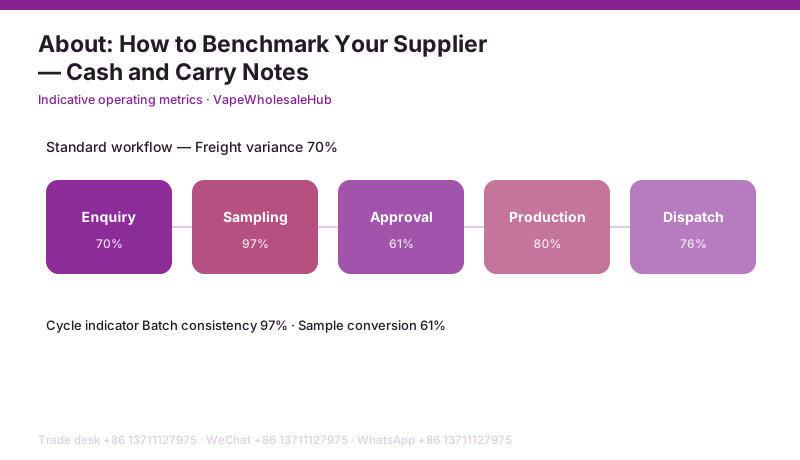
Most conversations about about: How to Benchmark Your Supplier — Cash and Carry Notes start in the wrong place. Someone asks for a price per unit before anyone has agreed what the unit actually is. This page works through the subject the way a purchasing desk experiences it, from the first sample request to the container arriving at the dock.
Where the supply actually comes from
On the sourcing side, about: How to Benchmark Your Supplier — Cash and Carry Notes comes down to how much of the chain you can see. A trading desk that only ever talks to a sales rep is buying on faith. We prefer accounts that ask for the factory audit, the mixing records and the batch numbers, because that paperwork is what protects everyone when a shipment is questioned later.
A useful test for about: How to Benchmark Your Supplier — Cash and Carry Notes is to ask two suppliers the same uncomfortable question and compare how long the answer takes. Serious operations have the data ready. Everyone else needs to check with someone, and that delay tells you how the next twelve months will feel.
What quality control looks like in practice
A quality system for about: How to Benchmark Your Supplier — Cash and Carry Notes should produce a number someone is accountable for. Defect rate per batch, days to resolution, repeat complaint rate. Without a number, quality becomes an opinion, and opinions do not survive a busy quarter.
Quality control on about: How to Benchmark Your Supplier — Cash and Carry Notes is unglamorous and repetitive, which is exactly why it works. Incoming inspection, fill weight checks, leak testing and a retained sample from every batch. None of this is clever; all of it is cheaper than a recall.
Freight, packaging and landed cost
Logistics decides whether about: How to Benchmark Your Supplier — Cash and Carry Notes is profitable more often than product quality does. A three day saving on a freight route is worth more per unit than most price negotiations, and it is usually easier to achieve. Mode choice, consolidation and customs pre-clearance are where the margin actually lives.
Packaging is part of logistics, not marketing. Cartons for about: How to Benchmark Your Supplier — Cash and Carry Notes need to survive stacking, humidity and a forklift operator having a bad Monday. We specify board grade and pallet pattern before we talk about print finish, because a damaged pallet costs more than any artwork upgrade recovers.
Technical detail worth understanding
Technically, about: How to Benchmark Your Supplier — Cash and Carry Notes is a set of tolerances rather than a single specification. Coil resistance varies, battery capacity degrades, and perception shifts with device temperature. Designing within those tolerances is what separates a product that works from one that works in the lab.
Specification drift is the quiet risk in about: How to Benchmark Your Supplier — Cash and Carry Notes. A unit approved in January is not necessarily the unit shipped in September unless the change control is tight. We document every revision, and we tell accounts before the change rather than after someone notices.
Order structure at a glance
| Item | Standard | Volume | Programme |
|---|---|---|---|
| Typical order unit | Master carton | Pallet | Full container |
| Documentation | COA + SDS | COA + SDS + batch record | Full technical file |
| Lead time | 2-4 working days | 5-10 working days | 15-25 working days |
| Customisation | Label only | Label + closure + bottle | Full OEM / ODM |
| Sampling | Charged, credited on order | Included in development | Multi-round approval |
| Indicative MOQ | 500 units | 2,500 units | 10,000 units |
| Development window | n/a | 10-15 working days | 10-15 + approval |
Common questions
What is the usual minimum order quantity?
Minimum order quantity depends on the line. Standard stock items typically start at a single master carton, while custom work, private label artwork and bespoke tooling carry higher thresholds because the setup cost has to be recovered. We publish the figure for each line rather than quoting one blanket number.
What shelf life should we plan around?
Unopened e-liquid is typically stable for around two years when stored cool and away from direct light, and device batteries lose capacity on a similar curve. We print manufacture dates and batch codes on every unit so stock rotation is straightforward.
Who do we contact for an enquiry?
Reach the wholesale desk directly on +86 13711127975. The same number works for WhatsApp and WeChat, which is usually the fastest route for specification sheets, photographs and order confirmations.
Related reading
- About and Regulatory Paperwork: What Changes — Wholesale Programme Notes
- About Vape Supply Notes 461
- About Vape Supply Notes 296
- How to Audit a About Production Run — Retail Chain Focus
- Wholesale About Vape Supply: A Buyer's Guide to record keeping — Independent Shop Notes
- About Vape Supply Notes 399
Talk to the wholesale desk. Specifications, MOQ, stock and freight options for about: How to Benchmark Your Supplier — Cash and Carry Notes.
Phone +86 13711127975 · WeChat +86 13711127975 · WhatsApp +86 13711127975